Paul’s conversion, a pivotal moment after his initial persecution of Christians, transformed him from Saul of Tarsus into a devoted apostle. This dramatic encounter on the road to Damascus (Acts 9) ignited a lifelong mission to preach Jesus Christ to both Jews and Gentiles throughout the Roman Empire. His subsequent journeys, meticulously documented in the Book of Acts and alluded to in his epistles, represent some of the most significant missionary endeavors in history.
Scholars generally delineate three major missionary journeys undertaken by Paul, often with a fourth implied or transitional journey that includes his voyage to Rome. Each journey was characterized by specific objectives, strategic route planning, and the establishment of nascent Christian communities in major urban centers.
The First Missionary Journey (c. 46-48 AD)
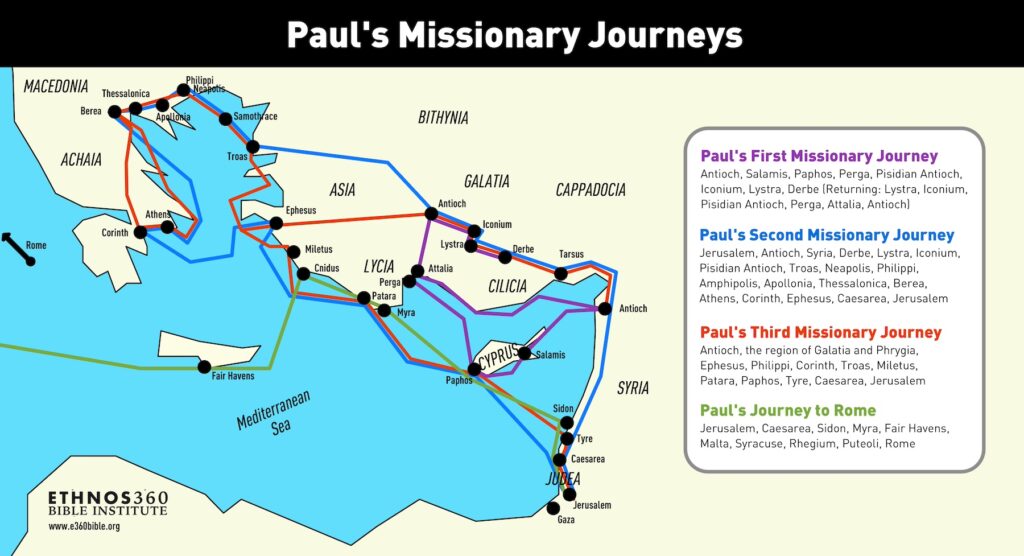
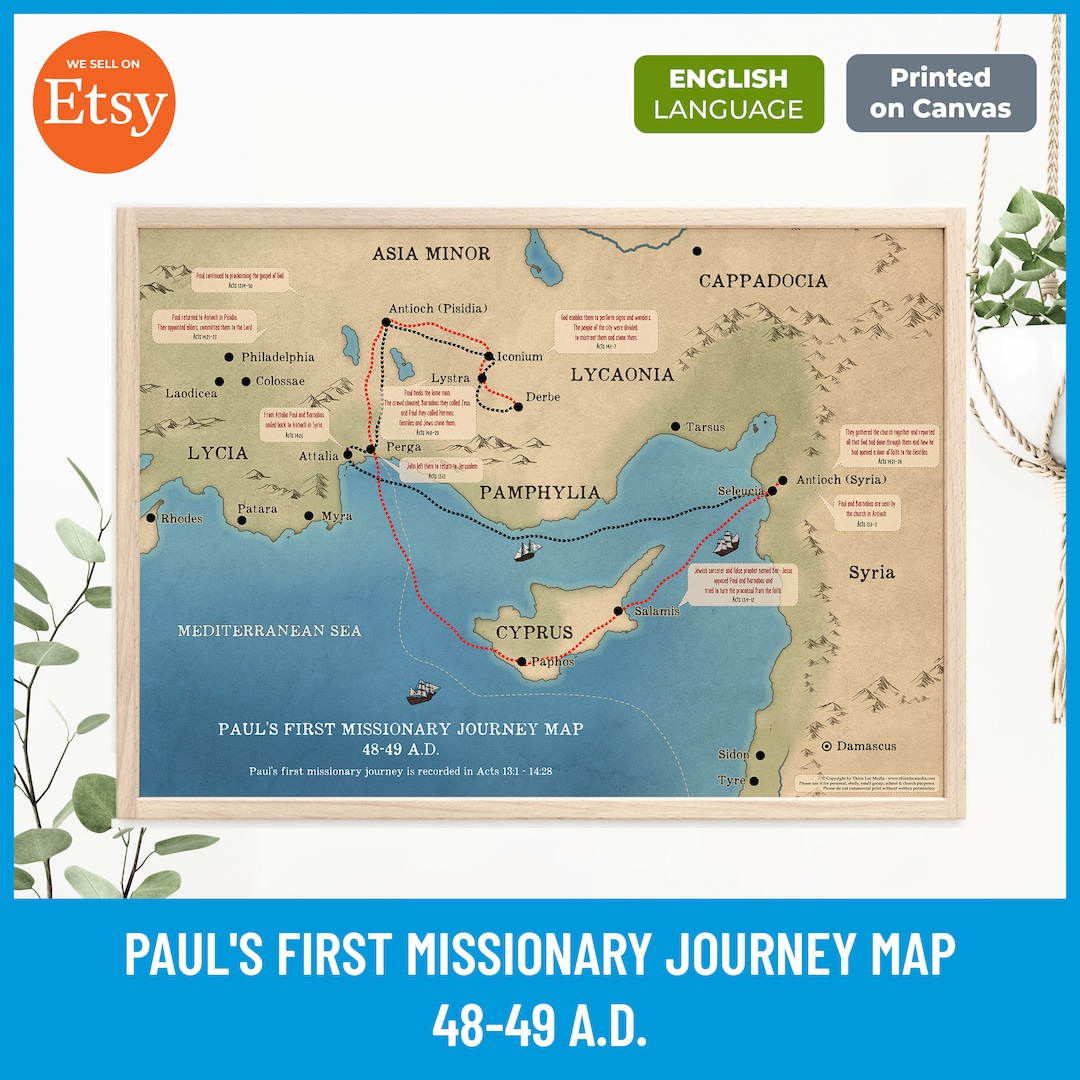
Paul’s inaugural journey began in Antioch, a significant Christian hub in Syria. Accompanied by Barnabas and John Mark, he set sail for Cyprus, Barnabas’s homeland. Here, they encountered Sergius Paulus, the Roman proconsul, whom Paul converted after confronting the sorcerer Elymas (Acts 13:6-12). This event highlights Paul’s early reliance on divine power and his confrontational approach when faced with opposition.
From Cyprus, they sailed to Perga in Pamphylia, on the coast of Asia Minor. It was here that John Mark departed from them, a point of contention that would later lead to a separation between Paul and Barnabas. Paul, undeterred, pressed on inland with Barnabas to Pisidian Antioch.
In Pisidian Antioch, Paul delivered his famous sermon in the synagogue, outlining the fulfillment of Old Testament prophecies in Jesus Christ (Acts 13:16-41). This sermon marked a turning point, as many Gentiles were drawn to the message, while Jewish leaders grew hostile, leading to Paul and Barnabas being expelled from the city. This pattern of initial acceptance followed by persecution would become a recurring theme.
Their ministry continued in Iconium, where they preached effectively but faced a plot to stone them, prompting their escape to Lystra. In Lystra, Paul healed a man lame from birth, leading the crowd to mistake them for the Greek gods Zeus and Hermes. However, stirred up by Jewish visitors from Antioch and Iconium, the mob stoned Paul, leaving him for dead (Acts 14:19). Miraculously, he recovered and, with Barnabas, continued their journey.
The final stops of this first journey included Derbe, where they made many disciples, and then a return route through Lystra, Iconium, and Pisidian Antioch to consolidate the new churches. They then traveled back to Perga, sailed to Caesarea, and finally returned to Antioch in Syria, concluding a journey that spanned roughly 1,200 miles and established churches in several key cities of Asia Minor.
The Second Missionary Journey (c. 49-52 AD)
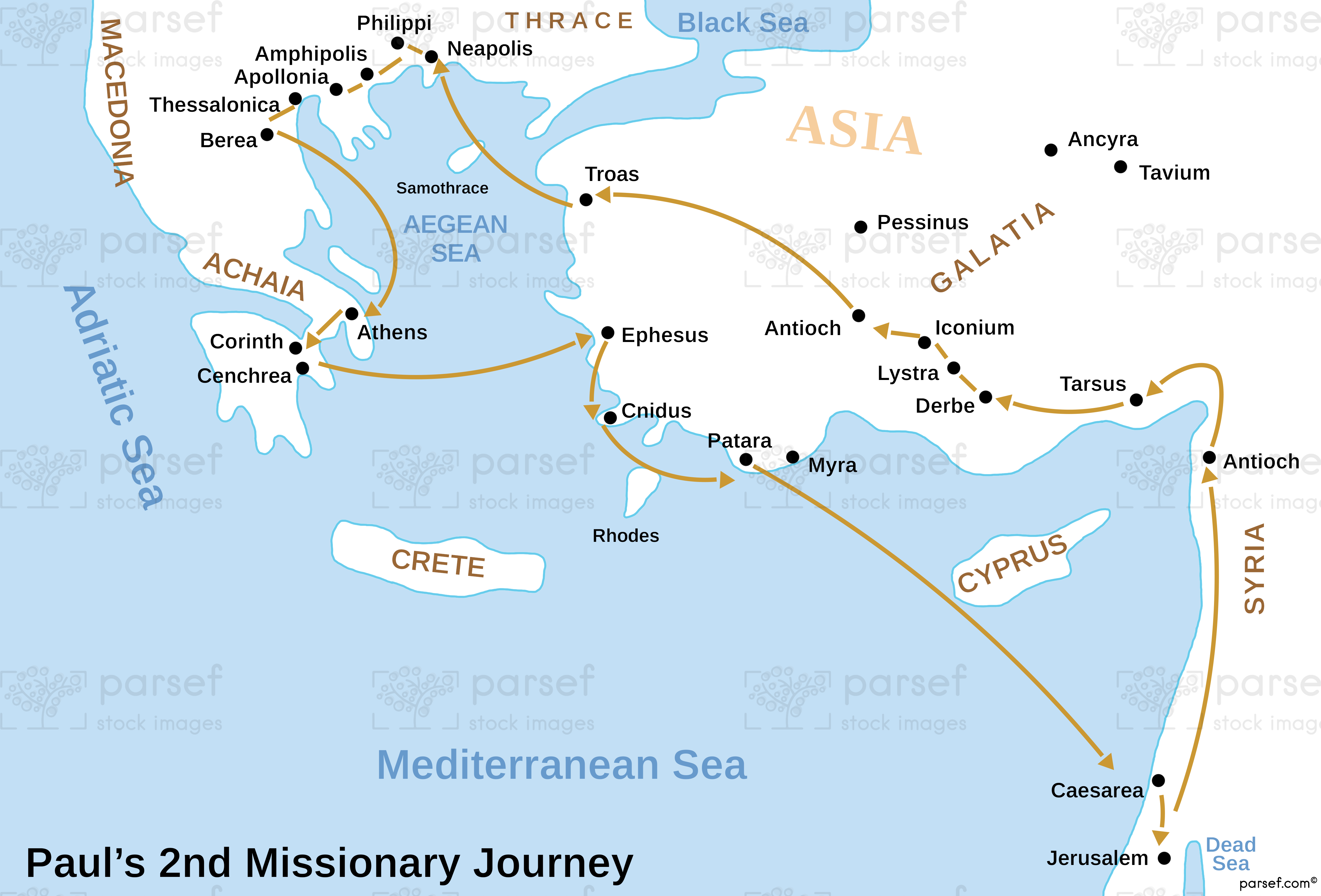
The second journey saw Paul set out again from Antioch, this time accompanied by Silas. Barnabas had departed with John Mark. Their initial route was overland, retracing steps through Syria and Cilicia, strengthening the churches established during the first journey.
A significant event occurred when Paul encountered Timothy in Lystra. Timothy, whose mother was Jewish and father Greek, impressed Paul with his faith and character. Paul circumcised Timothy to facilitate his ministry among the Jews, recognizing the importance of cultural sensitivity (Acts 16:3). Timothy became a close and invaluable companion, often referred to as Paul’s ‘son in the faith’.
The team intended to travel into the Roman province of Asia, but the Holy Spirit restricted them. Instead, guided by a vision of a Macedonian man pleading, ‘Come over to Macedonia and help us,’ Paul and his companions crossed the Aegean Sea to Europe for the first time (Acts 16:9-10). This marked a monumental shift, bringing the Gospel to the European continent.
Their first European stop was Philippi, a Roman colony. Here, Paul encountered Lydia, a seller of purple cloth, who became the first convert in Europe. In Philippi, Paul and Silas also faced a severe ordeal when they were unjustly imprisoned after casting out a spirit of divination from a slave girl (Acts 16:16-24). A miraculous earthquake freed them, leading to the conversion of the jailer and his household. This experience profoundly shaped Paul’s theology of suffering and perseverance.
Moving on, they traveled through Amphipolis, Apollonia, and Thessalonica, where Paul preached in the synagogue for three weeks. Despite making converts, hostility from Jewish leaders forced them to flee to Beroea. The Beroeans were commended for their noble spirit, examining the Scriptures daily to verify Paul’s message (Acts 17:11). However, trouble followed from Thessalonica, compelling Paul to leave for Athens alone.
In Athens, Paul famously debated philosophers on Mars Hill (Areopagus), presenting the Gospel in a way that resonated with Greek intellectualism, even referencing an ‘unknown god’ (Acts 17:23). While some were intrigued, many mocked him. He preached about the resurrection, which was a stumbling block for many.
Paul was soon joined by Silas and Timothy in Corinth, a bustling, cosmopolitan city notorious for its moral laxity. Here, he spent eighteen months, supported by Priscilla and Aquila, tentmakers like himself. He established a strong church in Corinth, writing the Epistles to the Thessalonians from this base.
Facing continued opposition from the Jews, Paul appeared before the proconsul Gallio in Corinth (Acts 18:12-17). Gallio’s refusal to interfere in religious disputes inadvertently protected the fledgling Christian movement.
The journey concluded with a return to Antioch, via Ephesus, where Paul left Priscilla and Aquila. This second journey covered a vast area, including parts of Greece and Macedonia, and was instrumental in establishing churches in key European cities.
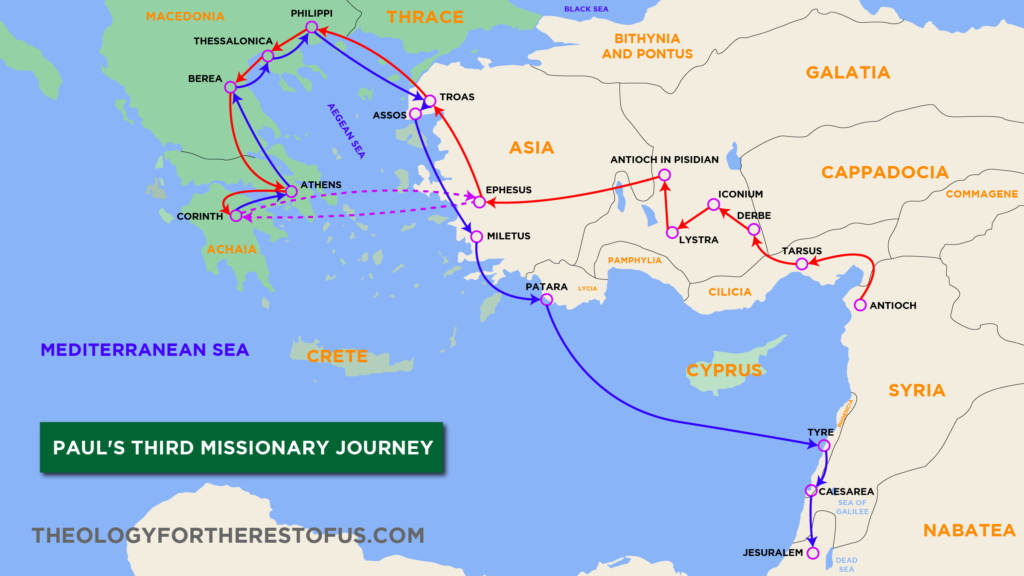
The Third Missionary Journey (c. 53-57 AD)
Paul’s third major expedition began once again from Antioch, primarily focused on revisiting and strengthening the churches established in Asia Minor and Greece. He traveled overland, passing through Galatia and Phrygia, reinforcing the disciples.
His primary focus during this journey was Ephesus, a major port city and the capital of the Roman province of Asia. Paul spent an extended period, approximately three years, ministering in Ephesus (Acts 19:1-41). This was perhaps his most impactful single ministry location.
In Ephesus, Paul encountered disciples who had only received John’s baptism. He explained the significance of baptism in the name of Jesus and the reception of the Holy Spirit. His ministry there was marked by powerful miracles, including healings and the expulsion of demons, which led to the conversion of many.
The effectiveness of Paul’s preaching caused unrest among the local silversmiths, who profited from selling idols of the goddess Artemis. A riot ensued, instigated by Demetrius the silversmith, threatening Paul’s life and forcing him to leave the city (Acts 19:23-41). This event underscores the economic and social disruption caused by the spread of Christianity.
After leaving Ephesus, Paul traveled to Macedonia, visiting the churches he had established there. He then moved on to Greece, spending three months in Corinth, likely writing his Epistle to the Romans during this period.
His planned sea voyage back to Syria was thwarted by a plot against his life. Consequently, Paul returned to Macedonia, traveling northwards. He met with his companions in Troas, where he famously raised Eutychus from the dead after the young man fell from a window during a lengthy sermon (Acts 20:7-12).
Paul then made his way down the coast of Asia Minor, stopping at Miletus. Here, he delivered a poignant farewell address to the elders of the Ephesian church (Acts 20:17-38). He foretold their future struggles and urged them to remain faithful to the Gospel, emphasizing his own selfless service and his determination to complete his ministry.
This journey was characterized by a deeper consolidation of existing churches, a prolonged and impactful ministry in Ephesus, and a growing awareness of the dangers Paul faced, leading to increased caution in his travel plans.
The Journey to Rome (c. 57-60 AD)
While not a missionary journey in the same sense as the previous three, Paul’s voyage to Rome represents the culmination of his life’s work and a divine appointment. After his arrest in Jerusalem and subsequent trials in Caesarea, Paul exercised his right as a Roman citizen to appeal to Caesar (Acts 25:11).
The journey began from Caesarea, with Paul entrusted to the care of Julius, a centurion of the Augustan cohort. They sailed towards Adramyttium, accompanied by Luke and Aristarchus. The voyage was fraught with peril, marked by adverse weather conditions and the ship’s eventual wreck off the coast of Malta (Acts 27).
During the shipwreck, Paul’s leadership and calm demeanor were evident. He reassured the sailors and passengers, demonstrating faith amidst chaos. On Malta, the inhabitants treated them kindly, and Paul experienced a notable incident where he was bitten by a viper but suffered no ill effects, further solidifying his divine protection in the eyes of the locals (Acts 28:1-6).
After three months on Malta, they finally reached Puteoli (modern Pozzuoli) in Italy. From there, Paul traveled overland to Rome, where he was met by fellow believers from the city, a testament to the network of faith he had helped establish.
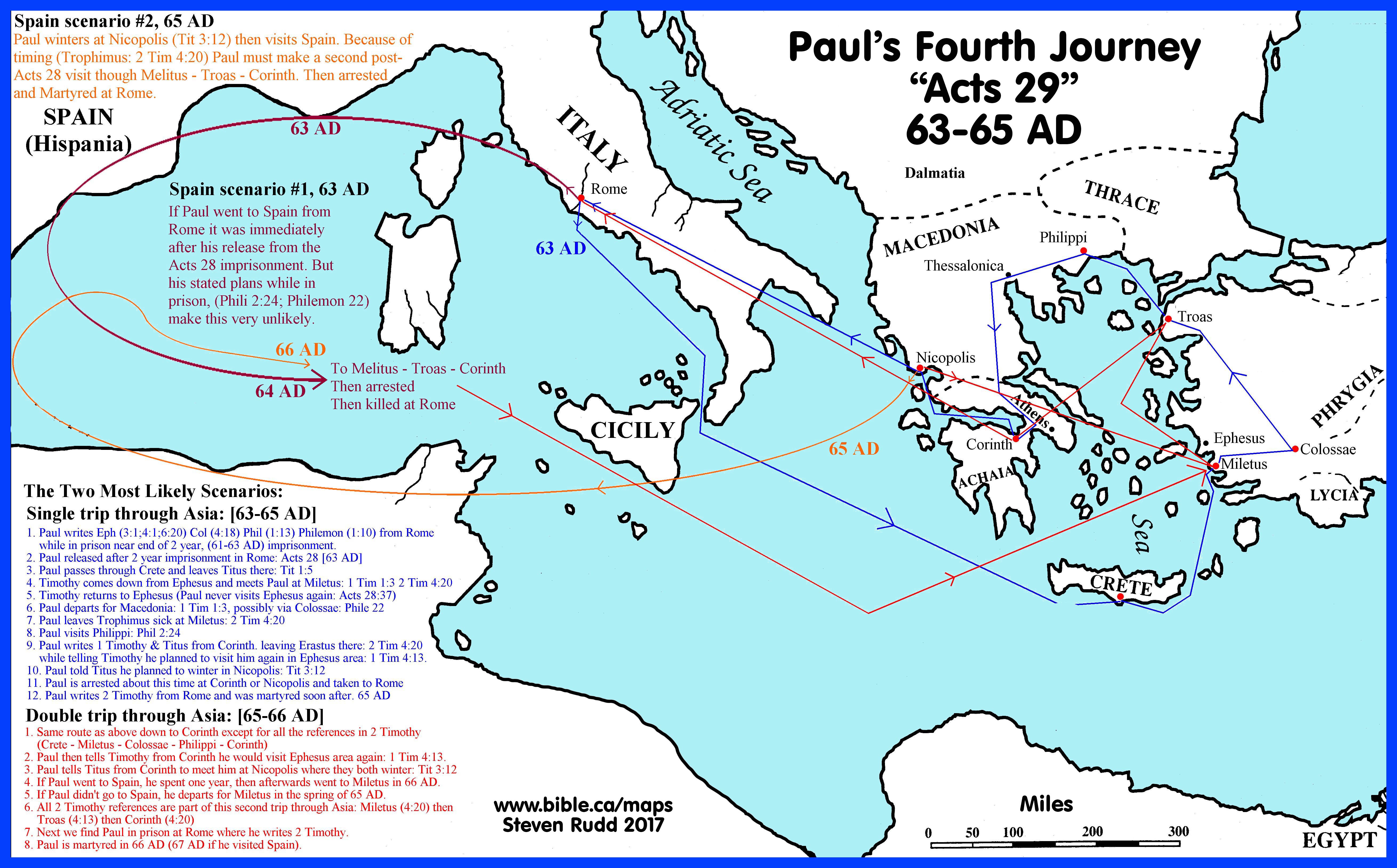
Upon arrival in Rome, Paul was allowed to live in his own hired house under house arrest, with freedom to preach and receive visitors. He spent two years in Rome, boldly proclaiming the kingdom of God and teaching about the Lord Jesus Christ without hindrance (Acts 28:30-31). This period resulted in the conversion of many, including members of Caesar’s household, and the writing of several key epistles, such as Ephesians, Philippians, Colossians, and Philemon.
The Impact and Legacy
Paul’s journeys were not merely geographical expeditions; they were strategic missions that fundamentally reshaped the religious landscape of the Roman world. He planted churches, trained leaders, and provided theological grounding through his epistles, many of which became foundational texts for Christian doctrine.
His ability to adapt his message to diverse audiences – from Jewish synagogues to Greek philosophical circles – demonstrates remarkable intellectual and spiritual agility. He understood the cultural contexts and addressed people where they were, using language and concepts they could grasp.
The challenges Paul faced – persecution, imprisonment, shipwrecks, riots, and personal betrayals – only underscore the extraordinary resilience and unwavering commitment that characterized his ministry. His willingness to suffer for the sake of the Gospel inspired countless others.
Maps illustrating Paul’s journeys visually represent the sheer scale of his undertaking. They show a determined man traversing thousands of miles by sea and land, facing immense dangers, all driven by a singular purpose: to spread the message of salvation through Jesus Christ.
The establishment of churches in major Roman cities like Antioch, Ephesus, Corinth, and Philippi created centers from which the faith continued to spread. These communities became the ‘salt and light’ in their respective regions, influencing the moral and spiritual fabric of the Roman Empire.
In conclusion, the journeys of the Apostle Paul are a profound narrative of faith, courage, and strategic evangelism. From the bustling streets of Antioch to the philosophical heart of Athens and the imperial center of Rome, Paul’s tireless efforts laid the groundwork for a global religion. His example continues to inspire missionaries and believers today, reminding us of the transformative power of the Gospel and the dedication required to share it.
Understanding these journeys provides invaluable context for the New Testament, highlighting the spread of early Christianity beyond its Jewish origins and its engagement with the wider Greco-Roman world. The maps of his travels are more than just lines on a page; they are pathways of faith that changed the course of history.