The complexity of New York’s airspace is legendary. The region is one of the busiest in the world, handling over 130 million passengers annually across its system. Whether you are flying internationally or hopping on a domestic shuttle, choosing the right airport depends heavily on your final destination within the city, your budget, and your tolerance for public transportation.
The Big Three: An Overview of NYC’s Primary Hubs
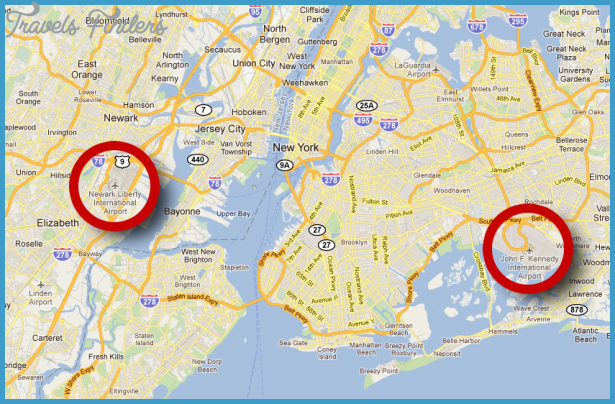
When looking at a map of New York City airports, three names dominate the landscape: John F. Kennedy International Airport (JFK), LaGuardia Airport (LGA), and Newark Liberty International Airport (EWR). While Newark is technically located in New Jersey, it is considered a co-primary airport for NYC and is often the best option for travelers headed to the west side of Manhattan.
These three airports form a triangle around Manhattan. JFK and LaGuardia are located in the borough of Queens to the east, while Newark sits to the west across the Hudson River. Understanding this geographical layout is the first step in mastering NYC travel.
John F. Kennedy International Airport (JFK): The International Giant
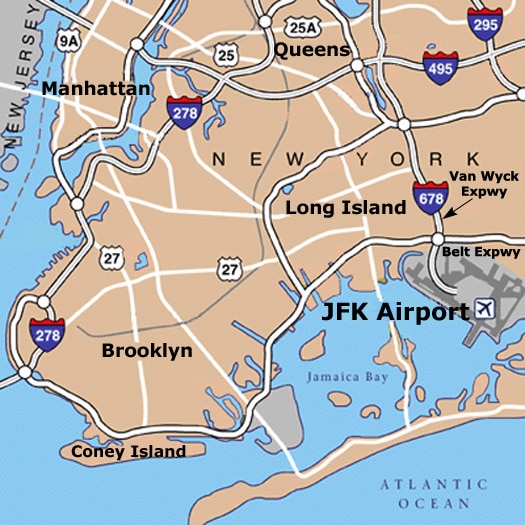
Located in Jamaica, Queens, roughly 16 miles southeast of Midtown Manhattan, JFK is the crown jewel of New York’s aviation system. It is the primary gateway for international travelers and the busiest international air passenger gateway into North America. On the map, JFK is located deep in Queens, overlooking Jamaica Bay.
- Terminals: JFK is massive, consisting of six active terminals (1, 4, 5, 7, and 8) connected by the AirTrain system.
- Airlines: It is a major hub for Delta Air Lines, American Airlines, and JetBlue, and hosts over 70 international carriers.
- Best For: International flights, long-haul domestic routes, and travelers staying in Brooklyn or Queens.
Getting to and from JFK requires planning. The AirTrain connects passengers to the NYC Subway (A, E, J, and Z lines) and the Long Island Rail Road (LIRR) at Jamaica Station. While the LIRR is faster, the subway is more economical. Taxis and rideshares offer flat rates to Manhattan, but traffic on the Van Wyck Expressway can be unpredictable.
LaGuardia Airport (LGA): The Domestic Hub
LaGuardia Airport is the closest airport to Manhattan, located in East Elmhurst, Queens, just 8 miles from Midtown. Historically known for outdated infrastructure, LGA has undergone a multi-billion dollar redevelopment, transforming it into a world-class facility. On the map, it sits on the northern edge of Queens, bordering Flushing Bay and the East River.
- Terminals: The airport has been consolidated into fewer, more efficient terminals (Terminal B and Terminal C) with state-of-the-art amenities.
- Airlines: It is a key hub for Delta and American Airlines, focusing primarily on domestic and short-haul international flights (like Canada).
- Best For: Business travelers, domestic flights, and anyone needing quick access to Midtown or the Upper East Side.
Transportation to LaGuardia is unique because it is the only major NYC airport without a direct rail link. Travelers must rely on the M60 Select Bus Service, the LaGuardia Link Q70 bus (which connects to the subway), taxis, or rideshare apps. Due to its proximity, a cab ride to Midtown is often shorter and cheaper than from JFK or Newark, assuming traffic is manageable.
Newark Liberty International Airport (EWR): The West Side Gateway
Situated in Newark and Elizabeth, New Jersey, EWR is approximately 15 miles southwest of Midtown Manhattan. For travelers looking at an airports in New York map, Newark often appears deceptively far, yet it is frequently the fastest option for reaching Lower Manhattan or the West Side via train.
- Terminals: Newark operates Terminals A, B, and C. Terminal C is a massive hub for United Airlines.
- Airlines: United Airlines dominates EWR, controlling a significant portion of the traffic. It is also a major international gateway.
- Best For: Travelers staying in West Manhattan, the Financial District, or Jersey City; United Airlines loyalists.
The AirTrain Newark connects the terminals to the NJ Transit and Amtrak rail station. From there, a train ride to New York Penn Station takes about 30 minutes. This rail connectivity makes Newark a strong competitor to JFK for efficiency, particularly during rush hour when road traffic is gridlocked.
Mapping the Secondary Airports
While the ‘Big Three’ handle the vast majority of traffic, a comprehensive map of airports in the New York area includes several regional options. These airports can offer cheaper fares, easier parking, and less congestion, depending on your final destination.
New York Stewart International Airport (SWF)
Located in Newburgh, NY, roughly 60 miles north of Manhattan, Stewart is a growing alternative. It is often marketed as a low-cost option for travelers heading to the Hudson Valley or those willing to take a bus connection to NYC. It hosts budget carriers and some international flights.
Westchester County Airport (HPN)
Situated in White Plains, about 30 miles north of Manhattan, HPN is a favorite for business travelers and residents of the northern suburbs and Connecticut. It is small, easy to navigate, and serviced by major carriers like JetBlue, Delta, and American for regional flights.
Long Island MacArthur Airport (ISP)
Located in Islip, roughly 50 miles east of Manhattan, ISP serves the population of central and eastern Long Island. While not convenient for a Manhattan tourist, it is an excellent option for those visiting the Hamptons or Nassau/Suffolk counties. Southwest and Frontier are the primary carriers here.
Teterboro Airport (TEB)
If you look closely at a map of New Jersey just across the river from Manhattan, you will see Teterboro. However, do not plan on booking a commercial ticket here. TEB is dedicated exclusively to general aviation and private charters. It is the playground for VIPs and corporate executives entering the city.
Comparing Distances to Major Landmarks
- From LGA: 30-45 minutes (Road). Closest geographically.
- From JFK: 60-90 minutes (Road) or 50-60 minutes (Rail).
- From EWR: 45-60 minutes (Road) or 30-45 minutes (Rail).
For the Financial District (Wall Street), Newark is often the winner due to the proximity of the Holland Tunnel and the PATH train connections from Newark Penn Station, whereas JFK and LGA require traversing the length of Brooklyn or Queens.
Transportation Logistics: Connecting the Dots
-
NYC Airporter / Express Buses: Dedicated shuttle services that run between the major hubs.
-
Rideshare/Taxi: The most direct but expensive method. A transfer from JFK to EWR can cost upwards of $100 depending on surge pricing.
-
Public Transit: This is the cheapest but most time-consuming option, often requiring transfers through Manhattan (e.g., taking the AirTrain from JFK to Penn Station, then NJ Transit to EWR).
Strategic Tips for Choosing Your Airport
1. Check the Map Against Your Hotel: If you are staying in Brooklyn, JFK is your best bet. If you are in Midtown West, Newark might be faster than JFK. For the Upper East Side, LaGuardia is unbeatable.
2. Factor in Time of Day: During rush hour (7-10 AM and 4-7 PM), crossing bridges and tunnels can add an hour to your commute. Rail links at JFK and EWR are immune to traffic jams, making them safer bets for tight schedules during peak times.
3. Price vs. Convenience: Sometimes a flight into Newark is $50 cheaper, but the cab fare to Brooklyn might be $50 more than from JFK. Always calculate the ‘total cost of arrival’ including ground transport.
Conclusion
Visualizing the airports in New York map is essential for any traveler navigating the complex logistics of the tri-state area. Whether you choose the international connectivity of JFK, the proximity of LaGuardia, or the rail efficiency of Newark, understanding where these hubs sit relative to your destination will ensure a smoother journey. By weighing factors like location, transport options, and airline hubs, you can master the skies and streets of New York City.